Nestjs Swagger Docs With Examples
2023-06-01
NestJS has a great integration with OpenAPI/Swagger, leveraging decorators to add request and response information to endpoints. For more information on how to use it: https://docs.nestjs.com/openapi/introduction.
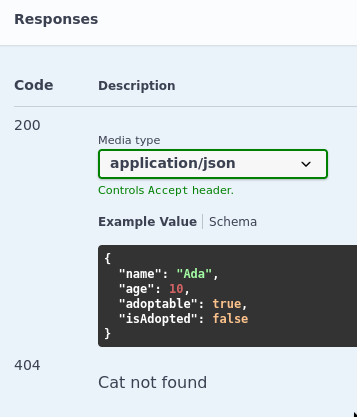
A simple response with example could look like this:
import { ApiOperation, ApiProperty, ApiResponse  } from "@nestjs/swagger";
import {
  Controller,
  Get,
  HttpStatus,
  NotFoundException,
  Param,
} from "@nestjs/common";

class Cat {
  @ApiProperty({ example: "Ada" })
  name: string;
  @ApiProperty({ example: 10 })
  age: number;
  @ApiProperty({ example: true })
  adoptable: boolean;
  @ApiProperty({ example: false })
  isAdopted: boolean;
}

const catStore: Map<string,Cat> = new Map<string,Cat>();
catStore["Ada"] = { name: "Ada", age: 10, adoptable: true, isAdopted: false }

@Controller({
  path: "/cat",
})
export class CatController {
  @Get("/:id")
  @ApiOperation({ summary: "My example get cat by id endpoint" })
  @ApiResponse({ status: HttpStatus.OK, type: Cat })
  @ApiResponse({
    status: HttpStatus.NOT_FOUND,
    description: "Cat not found",
  })
  getCatById(@Param("id") id: string): Cat {
    const cat = catStore.get(id);
    if (!cat) {
      throw new NotFoundException("Cat not found");
    }
    return cat;
  }
}
The generated docs look like that:
The Problem
Let’s say we want to have an endpoint to adopt a cat. Adopting a cat might have constrains we need to take into account and inform the user about.
For this example we will add two constrains: the cat hasn’t been adopted yet, and the cat wants to be adopted. We can define the “violations” for trying to adopt a cat that cannot be adopted and return them:
export class AdoptCatViolation {
  @ApiProperty({ example: "CAT_ALREADY_ADOPTED" })
  type: string;
  @ApiProperty({ example: "Cat already adopted" })
  description: string;
}

...

@Post("/:id/adopt")
@ApiOperation({ summary: "Adopt cat by id endpoint" })
@ApiResponse({ status: HttpStatus.OK, type: Cat })
@ApiResponse({ status: HttpStatus.UNPROCESSABLE_ENTITY, type: AdoptCatViolation })
@ApiResponse({
  status: HttpStatus.NOT_FOUND,
  description: "Cat not found",
})
adoptCatById(@Param("id") id: string): Cat {
  const cat = catStore.get(id);
  if (!cat) {
    throw new NotFoundException("Cat not found");
  }
  if (!cat.adoptable) {
    throw new UnprocessableEntityException(
      { type: "CAT_WANTS_TO_STAY_FREE", description: "Cat wants to stay free" }
    )
  }
  if (cat.isAdopted) {
    throw new UnprocessableEntityException(
      { type: "CAT_ALREADY_ADOPTED", description: "Cat already adopted" }
    )
  }
  cat.isAdopted = true;
  return cat;
}
We have handled the errors that can happen and returned them to the user. The documentation, however, only shows the generic AdoptCatViolation example. It is also possible to set an examples object (@ApiResponse({ examples: { ... } })) with more than one value, but the generated examples in the documentation don’t show them. This is what the Swagger docs look like:
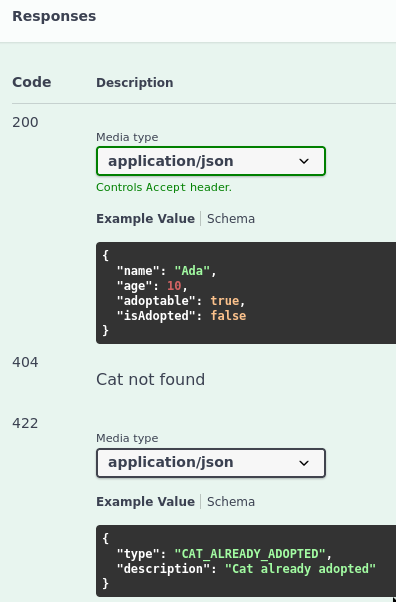
This can be enough for some cases, but I want to be able to generate the docs with all violations I know I might return, allowing the user to know about them before hand and handle them properly.
The solution
We have to go deeper into the params of @ApiResponse({ ... }) to specify the schema and the examples in the content field of the ApiResponseOptions. I wrapped it in a function to make it reusable:
import { ApiResponseOptions, getSchemaPath } from "@nestjs/swagger";
import { ExamplesObject } from '@nestjs/swagger/dist/interfaces/open-api-spec.interface';

private static createViolationResponseDocs(description: string, examples: ExamplesObject): ApiResponseOptions {
  return {
    status: HttpStatus.UNPROCESSABLE_ENTITY,
    description,
    content: {
      "application/json": {
        schema: { $ref: getSchemaPath(AdoptCatViolation) },
        examples,
      }
    }
  }
}
Let’s create a new adopt cat endpoint using the function. First we define the violations:
const adoptCatViolations: ExamplesObject = {
  "CAT_ALREADY_ADOPTED": {
    value: {
      type: "CAT_ALREADY_ADOPTED",
      description: "Cat already adopted",
    } as AdoptCatViolation
  },
  "CAT_WANTS_TO_STAY_FREE": {
    value: {
      type: "CAT_WANTS_TO_STAY_FREE",
      description: "Cat wants to stay free",
    } as AdoptCatViolation
  },
};
Now we can use the function to define the docs, and also use the violations as the param for the UnprocessableEntityException constructor.
@Post("/:id/adopt-with-nice-docs")
@ApiOperation({ summary: "Adopt cat by id endpoint" })
@ApiResponse({ status: HttpStatus.OK, type: Cat })
@ApiResponse(CatController.createViolationResponseDocs(
  "Cat already adopted or wants to stay free!",
  adoptCatViolations,
))
@ApiResponse({
  status: HttpStatus.NOT_FOUND,
  description: "Cat not found",
})
adoptCatByIdWithNiceDocs(@Param("id") id: string): Cat {
  const cat = catStore.get(id);
  if (!cat) {
    throw new NotFoundException("Cat not found");
  }
  if (!cat.adoptable) {
    throw new UnprocessableEntityException(
      adoptCatViolations["CAT_WANTS_TO_STAY_FREE"]
    )
  }
  if (cat.isAdopted) {
    throw new UnprocessableEntityException(
      adoptCatViolations["CAT_ALREADY_ADOPTED"]
    )
  }
  cat.isAdopted = true;
  return cat;
}
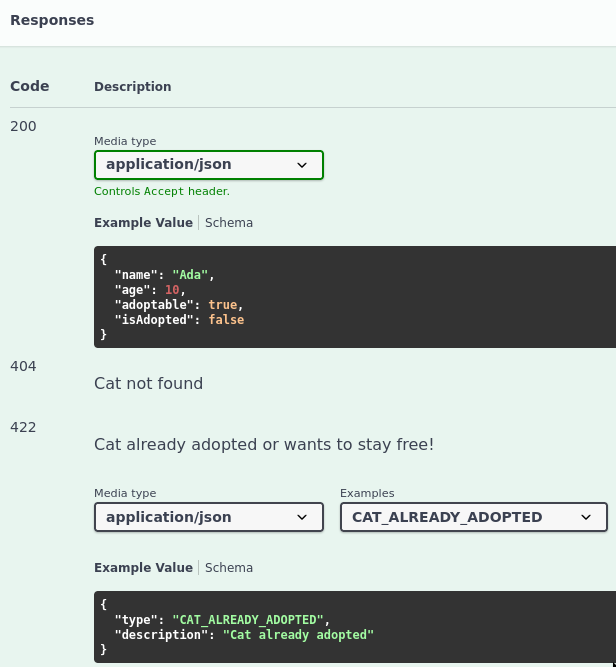
Now we have the docs with the possible violations as a dropdown menu for this endpoint:
Schema path
If the schema isn’t directly referenced as a response type (e.g. @ApiResponse({ type: AdoptCatViolation })), it has to be added to the NestJS app like that:
...
const options: SwaggerDocumentOptions = {
  extraModels: [AdoptCatViolation],
};
const document = SwaggerModule.createDocument(app, config, options);
...
For more information on it, see https://docs.nestjs.com/openapi/types-and-parameters#extra-models.
Final words
I hope this example helps others, it is a simple task but that took me a bit of research to find out how to do it. Here is a link to the complete example: https://git.sr.ht/~pedroscaff/nestjs-swagger-docs-example